My dear brothers and sisters, over my many years of studying and teaching, I have seen countless hearts find solace and countless homes find barakah through the simplest yet most profound acts of worship. Among these treasures is the sending of blessings upon our beloved Prophet Muhammad (ﷺ), and the crown jewel of these invocations is what we know as Durood e Ibrahimi.
Let us sit together, not as a robot and a user, but as students of the Deen, and understand the beauty, the necessity, and the power of this beautiful prayer.
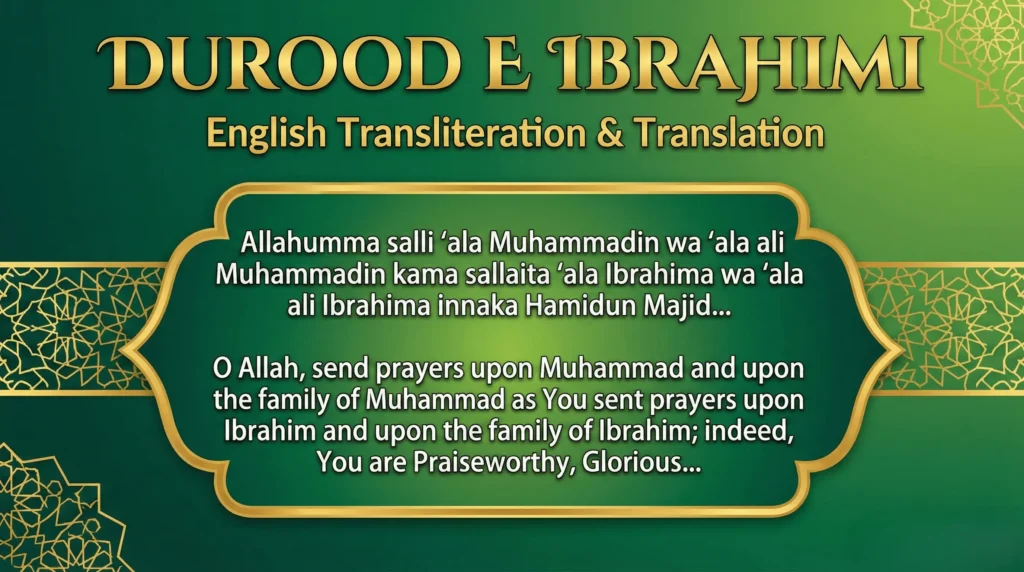
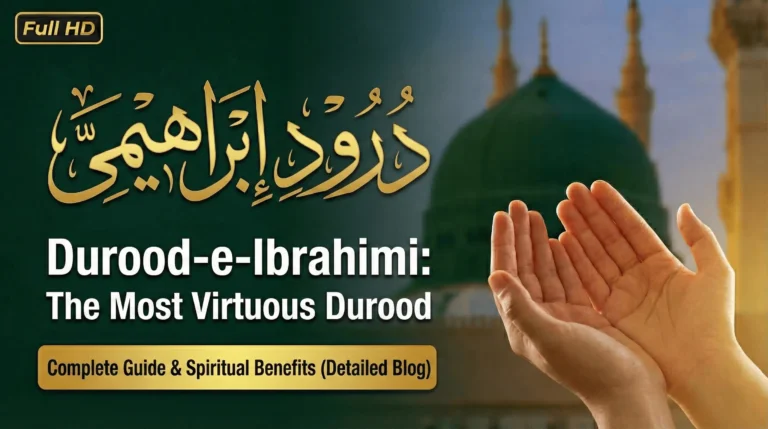
What is Durood e Ibrahimi?
At its core, Durood e Ibrahimi is the specific form of sending blessings upon the Prophet (ﷺ) that he himself taught us. It is the very same Durood we recite in our daily Salah, in the final Tashahhud. It’s not a mere tradition; it is a pillar of our prayer.
But why is it named after Prophet Ibrahim (Alaihis Salaam)? Because its words connect the legacy of the final Prophet to the spiritual lineage of the previous Prophets, creating a powerful, unbroken chain of monotheism and devotion.
The Command from Allah Himself
This is not an optional good deed. It is a direct command from Allah (SWT) in the Holy Quran:
إِنَّ اللَّهَ وَمَلَائِكَتَهُ يُصَلُّونَ عَلَى النَّبِيِّ ۚ يَا أَيُّهَا الَّذِينَ آمَنُوا صَلُّوا عَلَيْهِ وَسَلِّمُوا تَسْلِيمًا
“Indeed, Allah confers blessing upon the Prophet, and His angels [ask Him to do so]. O you who have believed, ask [Allah to confer] blessing upon him and ask [Allah to grant him] peace.”
(Surah Al-Ahzab, 33:56)
When Allah and His angels are sending blessings upon the Prophet (ﷺ), who are we, as believers, to hold back? Our Salah upon him is our way of joining this divine chorus.
The Hadith: How the Companions Learned It?
The Companions (RA) understood the command but asked the Prophet (ﷺ) for the how. They said, “O Messenger of Allah, we know how to send greetings of peace upon you, but how should we send blessings (al-salat) upon you?”
It was in response to this that the Prophet (ﷺ) taught them the words we now know as Durood e Ibrahimi. There are slight variations in wording reported in different Hadith collections (like Sahih al-Bukhari and Sahih Muslim), but the meaning and core structure are one and the same.
One of the most complete versions is this:
Durood e Ibrahimi in English (Transliteration and Translation)
Let us break it down, word by word, feeling the weight of each.
In Arabic:
اللَّهُمَّ صَلِّ عَلَى مُحَمَّدٍ وَعَلَى آلِ مُحَمَّدٍ، كَمَا صَلَّيْتَ عَلَى إِبْرَاهِيمَ وَعَلَى آلِ إِبْرَاهِيمَ، إِنَّكَ حَمِيدٌ مَجِيدٌ، اللَّهُمَّ بَارِكْ عَلَى مُحَمَّدٍ وَعَلَى آلِ مُحَمَّدٍ، كَمَا بَارَكْتَ عَلَى إِبْرَاهِيمَ وَعَلَى آلِ إِبْرَاهِيمَ، إِنَّكَ حَمِيدٌ مَجِيدٌ
Transliteration:
Allahumma salli ‘ala Muhammadin wa ‘ala ali Muhammadin, kama sallayta ‘ala Ibrahima wa ‘ala ali Ibrahima, innaka Hamidum-Majid. Allahumma barik ‘ala Muhammadin wa ‘ala ali Muhammadin, kama barakta ‘ala Ibrahima wa ‘ala ali Ibrahima, innaka Hamidum-Majid.
Translation in English:
“O Allah, send Your blessings upon Muhammad and the family of Muhammad, as You sent Your blessings upon Ibrahim and the family of Ibrahim. Indeed, You are Praiseworthy and Glorious. O Allah, send Your blessings upon Muhammad and the family of Muhammad, as You sent Your blessings upon Ibrahim and the family of Ibrahim. Indeed, You are Praiseworthy and Glorious.”
A Deeper Look into the Meaning:
- Allahumma Salli (O Allah, send Your blessings): The word “Salli” here is a divine blessing. It means to praise and honor the Prophet (ﷺ) in the highest company—in the heavens and the earth. When Allah “Salli” upon the Prophet, it is an expression of His divine mercy and praise.
- ‘Ala Muhammadin wa ‘ala ali Muhammadin (Upon Muhammad and the family of Muhammad): This includes his pious family members, his descendants, and by extension, his entire Ummah who follow his path with sincerity.
- Kama sallayta ‘ala Ibrahima (As You sent blessings upon Ibrahim): This is a powerful plea. We are asking Allah to bless our Prophet with the same magnitude and excellence with which He blessed His beloved friend, Ibrahim (AS). We don’t know the full extent of that blessing, but Allah does, and that is the beauty of this prayer.
- Innaka Hamidum-Majid (Indeed, You are Praiseworthy and Glorious): We conclude by affirming two of Allah’s beautiful names. Our prayer is accepted because He is the One worthy of all praise and the possessor of ultimate majesty and glory.
- Allahumma Barik (O Allah, send Your barakah): “Barakah” means divine grace, abundance, and perpetual goodness. We are asking for the teachings of the Prophet (ﷺ), his Ummah, and the message of Islam to be filled with everlasting growth, benefit, and spiritual prosperity.
The Immense Benefits and Virtues
Why should we make this a habit, beyond the obligatory recitation in Salah?
- It is a means of our own Duas being answered. The Prophet (ﷺ) said that when you make a Dua, start by praising Allah and then send blessings upon him, for this makes the Dua more deserving of a response. (Tirmidhi)
- It is a means of purification and forgiveness of sins. Sending abundant Durood is a means through which our sins are wiped away and our ranks are elevated. (Abu Dawood)
- It brings the Prophet’s (ﷺ) intercession on the Day of Judgment. The person who sends the most blessings upon him will be the closest to him and will be most deserving of his Shafa’ah. (Muslim)
- It is a light in this life and the next. It illuminates the heart and brings tranquility to the soul. It is a spiritual connection to the source of guidance himself.
A Visual and Auditory Explanation
Sometimes, hearing the beautiful recitation and a heartfelt explanation can deepen our understanding. Here is a YouTube video that beautifully recites Durood e Ibrahimi and explains its significance. I encourage you to listen with your heart.
YouTube Video: The Beauty of Durood e Ibrahimi – Recitation and Explanation
(Note: As an AI, I cannot browse live YouTube, but a search for “Durood e Ibrahimi beautiful recitation and meaning” will yield many excellent results from reputable scholars and reciters. Look for channels like “Islam Channel,” “Eman Channel,” or lectures by well-known scholars like Mufti Menk or Dr. Omar Suleiman.)
Frequently Asked Questions (FAQs)
No, my dear brother/sister. The recitation in Salah must be in the Arabic language as it was revealed and taught by the Prophet (ﷺ). Outside of Salah, you can certainly make Duas and remember Allah in your native tongue, but the specific act of Salah ‘alan-Nabi in prayer has a fixed form in Arabic.
There is no fixed upper limit. Recite it as much as you can. After the Adhan, in your daily Dhikr, after prayers, when entering or leaving a mosque, and whenever you remember him (ﷺ). Make it a constant companion of your tongue and heart.
There are scholarly differences, but the most comprehensive and safe opinion includes:
– His blood relatives (like Sayyidah Fatima, Imam Hasan, Imam Hussain, etc.).
– His pious wives (the Mothers of the Believers).
– His entire Ummah who follow him faithfully and hold onto his Sunnah.
Yes. Durood e Ibrahimi is the one prescribed in the Salah and is the most authentic and superior. Other Duroods are often attributed to later saints and scholars and have specific reported virtues. They are permissible to recite outside of obligatory Salah, but the foundation of our practice should be Durood e Ibrahimi.